Invisible Disability: What Is Life Like for People with Multiple Sclerosis in Uzbekistan?
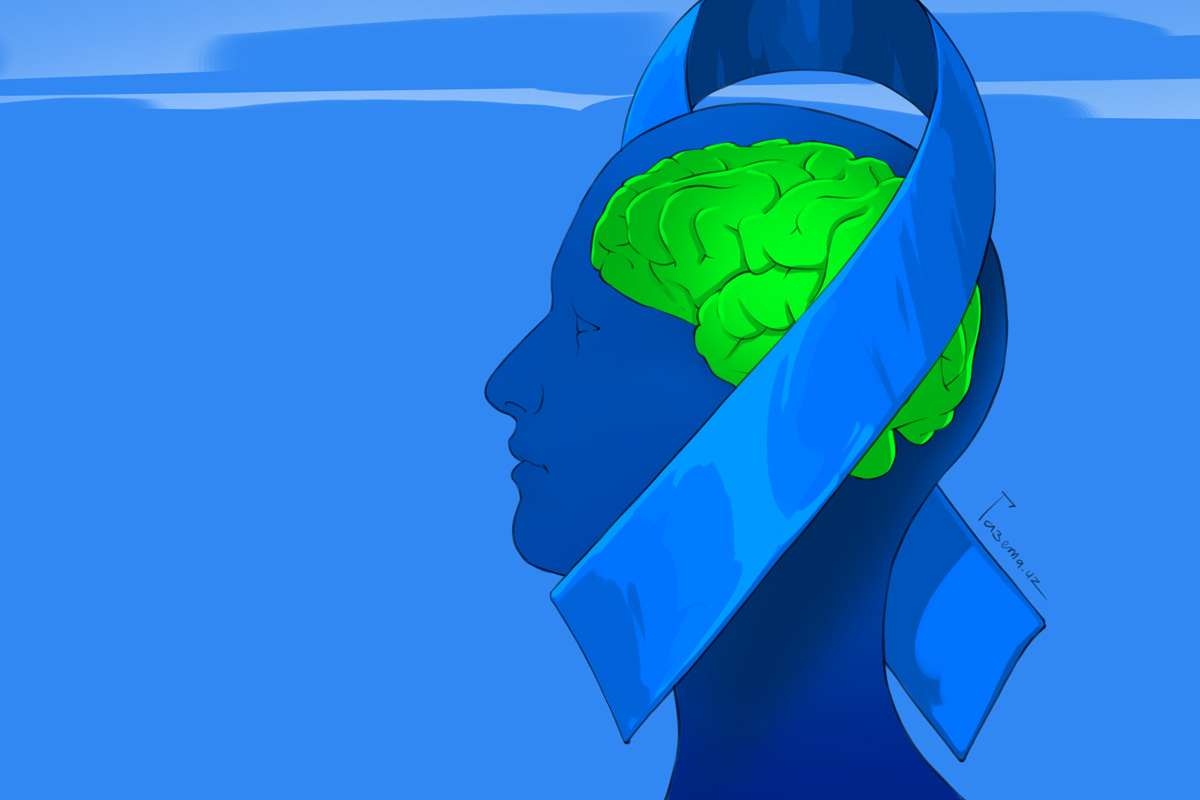
Illustration: Eldos Fazylbekov
In March 2025, I spoke with a group of people with multiple sclerosis in Uzbekistan to understand the difficulties they face in diagnosis and treatment, and what kind of government support they need. My op-ed for Gazeta.uz was published on 4 June dedicated to the World Multiple Sclerosis (MS) Day.
Every year on May 30, World Multiple Sclerosis (MS) Day is observed.
This is a chronic, progressive disease of the central nervous system that can lead to disability and a serious decline in the quality of life—not only for the patient but also for their loved ones. Multiple sclerosis is not only a medical condition but also a serious social issue that affects the patient, their family, society, and the state as a whole.
MS is diagnosed in tens of thousands of people around the world every year. Despite significant progress in global medicine, MS remains a disease that is difficult to diagnose and virtually impossible to treat effectively under the current conditions in our country. In Uzbekistan, this diagnosis is rarely discussed, and World MS Day went largely unnoticed by the public.
People with MS often do not realize the seriousness of their condition for a long time. In the early stages, they may spend years visiting various specialists with a wide range of symptoms without ever receiving an accurate diagnosis—and thus, they miss out on the necessary therapy.
Even after a diagnosis is made, many patients struggle to accept the disease, facing misunderstanding, stigma, and sometimes complete indifference from society. Many live with MS for years without telling anyone about their condition, because they have a hidden or invisible form of disability.
However, accepting the diagnosis does not bring relief. Patients face serious challenges in accessing modern treatments: the high cost of certified medications, their shortage on the market, and the risk of purchasing ineffective or counterfeit drugs all become real barriers. All of this breeds mistrust toward doctors, leads to attempts at self-treatment, and further worsens the course of the disease.
“The Disease with a Thousand Faces”
Multiple sclerosis is often called “the disease with a thousand faces” because it manifests differently in each person—varying in symptoms, severity, progression rate, and even emotional response. For most people, the word “multiple” suggests being scatterbrained, and “sclerosis” is associated with forgetfulness.
However, multiple sclerosis is a far more insidious and serious condition than it might appear at first glance. In fact, the term “multiple” refers to the numerous lesions in the central nervous system—both in the brain and spinal cord. This explains the diversity and unpredictability of the initial symptoms of the disease.
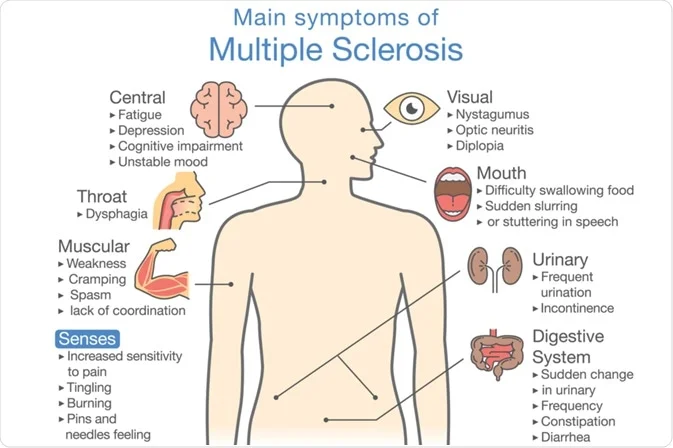
For example, one person might suffer from fatigue and numbness, another from vision and coordination problems, and a third from severe pain or cognitive impairments. And all of this—comes under the same diagnosis. MS is the leading cause of non-traumatic disability among young people aged 20 to 40.
“I was diagnosed ten years ago, and I’ve been in remission for seven years, thank God. Honestly, only my close family and a few friends know about my diagnosis. I work, and my colleagues don’t know either, so I’ve never brought it up in public or on social media,” explains a woman with MS, a member of the peer support group Kurashamiz (Let’s Fight), which brings together about 70 people living with MS in Uzbekistan.
While one person with MS may become fully paralyzed, another may remain in remission for decades. Remission is a period when MS symptoms diminish or disappear entirely, and the person feels almost healthy again. In other words, the disease may “go quiet” for a while, allowing the person to move, see, and work normally again.
Over time, symptoms may return and/or new ones may appear—this is known as an MS flare-up or relapse. Each relapse is caused by inflammation in nerve tissue, which eventually leaves behind a sclerotic plaque (sclerosis is essentially scar tissue). These changes gradually reduce the amount of functioning nerve tissue, leading to increasing neurological impairment and disability. The COVID-19 pandemic worsened the condition of people living with MS, triggering more frequent relapses.
The course of the disease is hard to predict in advance—it is individual and may be relapsing-remitting or progressively worsening. However, regardless of the form or severity of symptoms, without proper treatment, MS inevitably leads to loss of self-care ability, severe disability, and in some cases, death from complications.
“I’ve had four relapses, and after them I almost fully recovered. The only lingering issue is from retrobulbar neuritis (inflammation of the optic nerve)—that nerve never fully healed. I can’t correct my vision surgically, only with glasses. But otherwise, I’ve recovered completely,” says a woman diagnosed with MS in Uzbekistan.
Some patients partially recover after a relapse, but others never return to their previous physical condition. That’s why disease-modifying therapies (DMTs) are so important—they help slow disease progression and preserve quality of life.
How is multiple sclerosis treated?
In many countries around the world, disease-modifying therapies (DMTs) are widely used in MS treatment. These drugs help reduce the frequency of relapses and slow the progression of the disease. Countries like Turkey, Russia, and Kazakhstan already provide these medications to patients free of charge through state programs.
“Unfortunately, in Uzbekistan, access to DMTs is very limited. Many patients have to order medication from abroad on their own. On average, Chinese generics cost around $250 per month—for life. Most patients simply cannot afford that…” laments a member of the Kurashamiz support group.
In 2022, an international congress was held in Samarkand, gathering over 200 neurologists and researchers from Turkic-speaking countries. The event focused on new methods for diagnosing and treating MS. However, since then, there has been little progress in providing patients in Uzbekistan with access to modern DMTs.
Patients themselves are forming support groups like Kurashamiz, helping each other cope with the disease and find optimal treatments. Unfortunately, some unscrupulous doctors exploit patients by offering unproven or unapproved treatments in private clinics, even when they know these will not result in lasting improvements.
Many patients, especially in rural areas, turn to traditional healers due to a lack of reliable information in Uzbek and distrust of the medical system. This leads to lost time, wasted money, and missed opportunities for effective treatment.
“It’s very hard to find doctors who truly understand MS and can manage it properly. The modern specialists who treat MS usually recommend very expensive DMTs. But we simply can’t afford them. We’ve had to rely on dexamethasone every time there’s a relapse, constantly going in and out of hospitals,” says the mother of a 20-year-old patient who’s had MS since 2022.
As of today, Uzbekistan lacks a functional support system for people with MS at the primary care level. There are too few trained professionals capable of recognizing the disease early, no national clinical protocols for managing MS at different levels of care, and no specialized center where patients can be referred for diagnosis confirmation and treatment initiation.
How should the Uzbek government help?
Since July 2021, a group of MS activists has submitted several petitions to the Ministry of Healthcare, urging attention to state provision of access to disease-modifying therapies (DMTs). The petitions emphasized that without government funding, life-saving medications remain inaccessible to most people with MS in Uzbekistan.
Although DMTs are available and registered in Uzbekistan, they are not covered by state healthcare programs, so patients must pay for them out of pocket. Those who can afford it travel abroad for treatment—to Turkey, Russia, Germany, and other countries.
“In Turkey, an MRI with contrast for MS patients costs around $1,100; a professor’s consultation is $155; add travel, food, and accommodation expenses for a week, plus blood tests costing $500–600. If you see several specialists, the total treatment cost exceeds $5,000. Not everyone can afford that,” explains a woman with MS who underwent treatment in a Turkish clinic.
It is important to understand that treating a single relapse is only a temporary measure. MS patients require lifelong maintenance therapy aimed at slowing disease progression, reducing relapse frequency, and preserving quality of life.
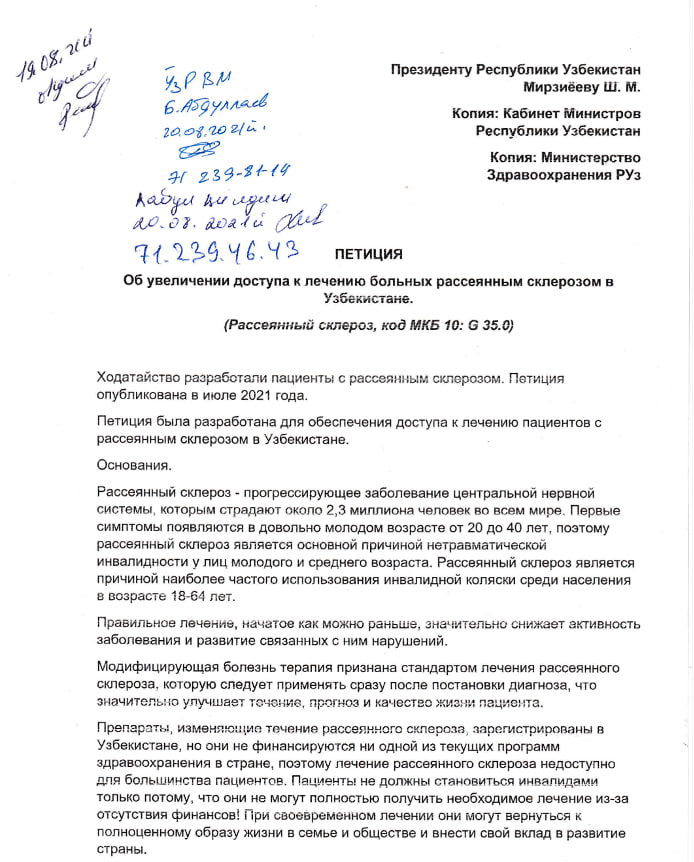
The authors of the petition to the Ministry of Health pointed out that the disability of many people could have been prevented if treatment were timely and accessible. In other words, people become disabled not because of the diagnosis itself, but because they cannot afford expensive medications or treatment abroad.
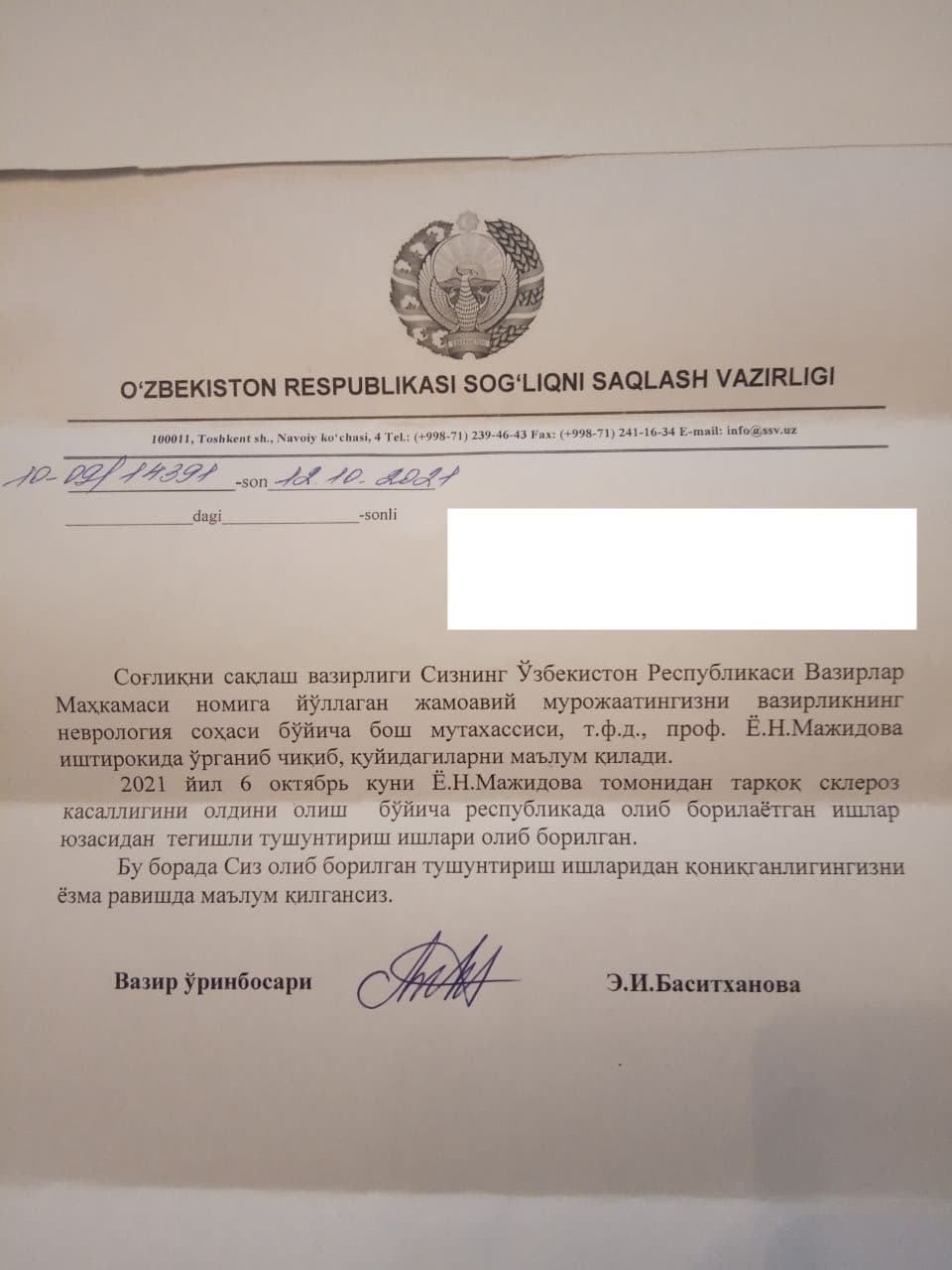
This was the first petition, but last year the group submitted it again to the Ministry of Health. For several years, volunteers have been working to gather signatures to request government assistance. However, for more than four years, this complex issue has remained unresolved by the Ministry. Unfortunately, all the group’s efforts have so far been unsuccessful, with the Ministry of Health responding only with formal replies that lack any concrete information about measures being taken to support MS patients through state programs.
How many people with MS are there in Uzbekistan?
According to the latest data from the International Multiple Sclerosis Federation, about 2.9 million people worldwide live with MS, which corresponds to approximately 36 cases per 100,000 people.
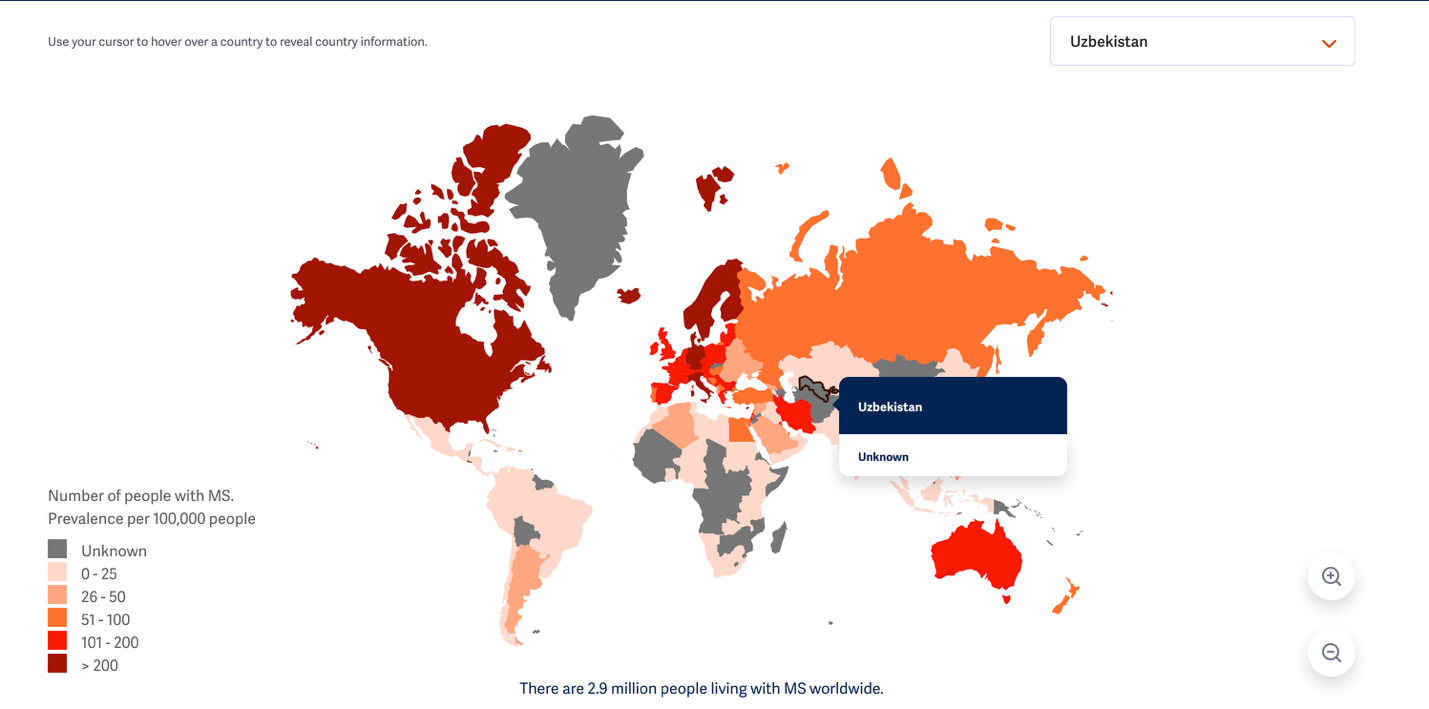
Unfortunately, there are no official statistics on people living with MS in Uzbekistan. The country’s chief neurologist at the Ministry of Health, Dr. Yokutkhon Madjitova, has begun collecting data from neurologists nationwide to create a national MS patient registry and to facilitate ongoing care. Preliminary data suggest there are about 1,000 patients with MS in Uzbekistan.
“But in reality, there may be many more people with MS — inaccuracies in statistics arise because, first, not all doctors can correctly diagnose the disease, and second, many diagnosed patients don’t register anywhere. I was diagnosed in a private clinic, and the local clinic near my home doesn’t know about my diagnosis,” shares a woman living with MS for over 10 years.
The professional community of neurologists in Uzbekistan needs to unite efforts to protect this therapeutic area and advocate for the interests of MS patients within the state healthcare system. It is also essential to improve the qualifications of medical personnel and raise standards of care for MS patients.
“At one of my first appointments during a relapse, a neurologist—who holds one of the highest positions in the republic—told me that in five years I would be in a wheelchair if I didn’t receive treatment in a neurologist’s clinic. So the issue of medical ethics is quite pressing,” says a woman living with MS.
It is important to draw public and government attention to the issue of providing MS patients with modern disease-modifying therapies (DMTs) funded by the state. This would improve patients’ quality of life and reduce levels of disability.
“Instead of running all over Tashkent searching for doctors, we need specialized clinics where they know how to treat MS purposefully. We have already had many bad experiences. There were cases when we were treated inadequately, and because of wrong treatment, we ended up in intensive care,” shares the mother of a young man with MS.
Concrete steps proposed by people with MS in Uzbekistan to improve the situation:
- Create a national MS patient registry to keep accurate records, plan resources, and monitor treatment effectiveness.
- Allocate state funding or at least co-financing for disease-modifying therapies (DMTs) and diagnostic expenses like MRI scans.
- Train doctors — develop programs for educating and upgrading the qualifications of specialists working with MS patients.
- Establish a specialized MS service — a critically important measure aimed at early diagnosis, timely therapy initiation, and proper patient management to prevent disability.
The voices of people living with MS in Uzbekistan need to be heard. Their appeals are not a whim but a necessity born of the fight for a dignified and active life. Patients are not asking for the impossible — they are asking for access to existing, scientifically validated treatments, along with attention and respect from the healthcare system.
We hope the Ministry of Health will take this problem seriously and begin systemic work to improve diagnosis, treatment accessibility, and support for people with MS. Every day of delay could cost someone their ability to move, work, and live without pain. The time to act is now!
The article was first published in Russian on 4 June 2025 at Gazeta.uz.