The Digital World Must Be Accessible to Everyone
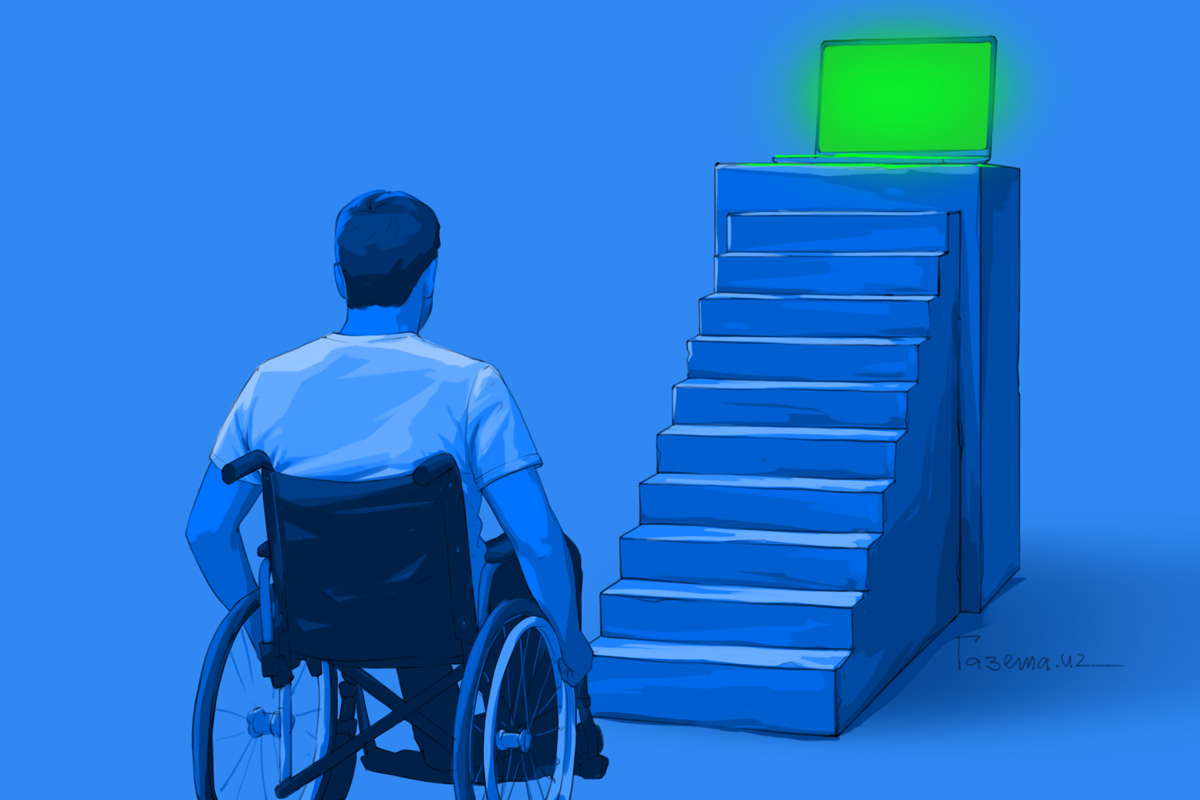
Illustration: Eldos Fazylbekov / “Gazeta.uz”
Are digital services in Uzbekistan accessible to all? How can we identify barriers in the online space and ensure universal access? Together with a digital accessibility expert in Uzbekistan Abdulaziz Salimov we wrote an op-ed for Gazeta.uz which was published on 15 May the Global Accessibility Awareness Day (GAAD).
In our society, when we talk about accessibility, people most often think of ramps — that is, physical infrastructure for people with disabilities and individuals with limited mobility. But accessibility must exist not only in the physical world, but also in the digital space. This means that online services should be convenient and understandable for people with various types of disabilities, as well as for anyone who needs additional support when using modern technologies.
Uzbekistan is confidently moving toward the creation of a digital state — this is an important and necessary step forward. However, behind modern interfaces and functionality, those for whom these technologies still remain not very accessible are often overlooked. And this is not just a matter of convenience, but of ensuring basic rights — the right to access information, to communicate, and to receive government, commercial, and other types of services.
Every year, on the third Thursday of May — this year, May 15 — the world observes Global Accessibility Awareness Day (GAAD). This global initiative is a reminder that websites, software, mobile applications, and other modern technologies should be convenient and accessible for everyone, including people with disabilities and others with special needs.
This day is a good reason for each of us to reflect: are the digital services we take pride in truly accessible to everyone? What does “digital accessibility” even mean? How can we identify the barriers that users face in the online space? And where should we start to ensure that technology becomes genuinely inclusive — not just in words, but in practice?
What is Digital Accessibility, and Who Needs It?
According to the World Health Organization, one in six people in the world is a person with a disability. In Uzbekistan, according to the National Agency for Social Protection, as of the end of the first quarter of 2025, there were officially 1,031,609 registered persons with disabilities, or 2.7% of the country’s total population. This number increases daily, and the real figure may be higher than existing administrative data suggests.
For many people, a digital barrier is just as real as a staircase without a ramp. Barriers in the digital environment are encountered not only by people with disabilities but also by elderly citizens: as of 2024, Uzbekistan had 3,467,800 residents over the age of 60 — that’s 9.4% of the total population. Additionally, those temporarily limited in mobility due to injury, as well as residents of remote areas where internet access remains unstable, may also struggle with accessing online services.
Digital accessibility is the principle of designing websites, apps, and online services in a way that makes them usable for everyone, including: blind and visually impaired individuals, deaf and hard-of-hearing people, individuals with motor disabilities; elderly users; and people with cognitive differences (such as dyslexia, autism, or other developmental conditions).
If a person cannot fully use a website simply because they have poor vision, cannot hear audio, cannot operate a mouse, or cannot navigate a cluttered interface — then digital accessibility has been violated. Unfortunately, this is the daily reality for tens of thousands of people. These barriers may seem minor to most, but for some, they turn a simple login or form submission into an impossible task. And this is about access to essential services — government assistance, healthcare, social protection, education, employment — to everyday life itself.
Digital Barriers
Even at the global level, digital accessibility remains a challenge. According to the latest WebAIM Million 2025 study, which analyzed one million website homepages, 96.3% of them still contain critical accessibility errors. Despite this, there has been some positive progress — compared to 2024, the number of errors has decreased by 10%. The most common issues include: low contrast between text and background, missing alt-text for images, unlabeled buttons, and links that are inaccessible to screen reader users. These seemingly minor flaws become serious obstacles for millions of people.
For example, blind users access information on a website not through their eyes but with the help of a screen reader — software that “reads aloud” everything displayed on the screen. Popular screen readers include:
- JAWS (Job Access With Speech),
- NVDA (NonVisual Desktop Access),
- VoiceOver for macOS and iOS (built into Apple devices), and
- TalkBack (the built-in screen reader for Android devices).
These are used by default on most smartphones.
However, for a screen reader to read content correctly, website elements must be properly marked up.
That’s why all important images on a site should have alternative text descriptions (alt-text) — short textual descriptions read aloud by the screen reader in place of the image. In addition, a correct structure of headings and properly labeled buttons are key components of digital accessibility. For instance, if a button displays a printer icon and has an alt text like alt="Print" — a person with a visual impairment will understand what that button does. When such descriptions are missing, visually impaired users lose the ability to fully interact with the site, and access to essential information becomes impossible.
Another vital aspect of digital accessibility is the ability to fully navigate and interact with a website without using a mouse — using only a keyboard. Keyboard navigation is critically important for people with motor impairments, as well as for screen reader users.
Yet this is where subtle but serious errors often arise. For example, developers may use incorrect semantics for interactive elements. Visually, it looks like a button: it’s styled, clickable, and performs an action. But in the code, it might be implemented as a regular <div> or <a> tag without the proper attributes or roles.
As a result, these elements aren’t recognized by screen readers or keyboard navigation tools, making them inaccessible to a significant portion of users. This is especially problematic for blind individuals — the screen reader doesn’t announce that the element is interactive, so they simply “skip past” an important function of the site.
First Steps Toward Digital Equality in Uzbekistan
The Unified Portal of Interactive Government Services — my.gov.uz — is becoming a pioneer of digital accessibility in our country. Since May of last year, the portal has set an excellent example for other government agencies by hiring digital accessibility expert Abdulaziz Salimov, who is visually impaired. In doing so, the government agency not only provided a disabled person a decent job but also ensured the digital accessibility of its online platform.
Currently, the inclusive team at my.gov.uz is gradually implementing WCAG (Web Content Accessibility Guidelines) standards. This is an internationally recognized set of guidelines considered the gold standard for digital accessibility in more than 60 countries worldwide.
“A full digital accessibility audit was conducted on the my.gov.uz portal, errors were identified and corrected. We adapted the navigation for screen readers, increased contrast, added the ability to control the interface using only a keyboard, and we continue testing the portal with real users with disabilities. In addition, work is underway to adapt the my.gov.uz mobile application for users with various types of disabilities,” says Abdulaziz Salimov, a specialist in the UPIGS development department.
In addition, the my.gov.uz portal has implemented a virtual assistant, Muxlisa AI — a chatbot located in the bottom-right corner of the screen. Initially, its interface was primarily designed for visual interaction (mouse, touchscreen), but later, script-based solutions were implemented that significantly improved its accessibility for users with visual and motor impairments.
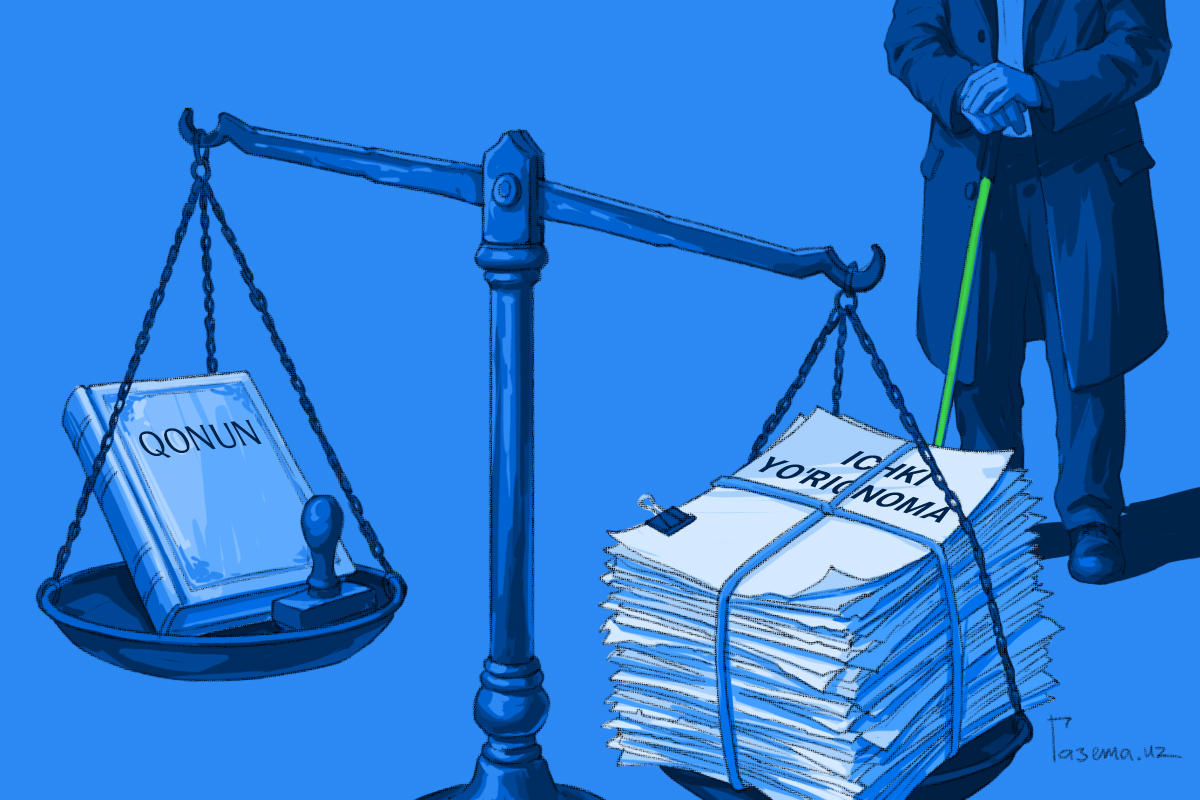
Unfortunately, as of today, Uzbekistan does not have a separate national standard regulating the digital accessibility of websites and online services. However, back in 2013, certain requirements were introduced for the official websites of government agencies — including mandatory features like high-contrast modes, font enlargement, audio support, and other accessibility elements.
Nevertheless, these measures cover only a portion of the broader challenge: changing contrast or font size are just individual components of a much wider concept — digital accessibility.
According to Article 9 of the UN Convention on the Rights of Persons with Disabilities, ratified by Uzbekistan in 2021, the state is obligated to ensure equal access to digital platforms — including websites, applications, electronic document systems, and other ICT tools. Article 21 of the Convention also includes the provision of information in alternative formats (e.g., audio narration, subtitles, simplified text), as well as the technical implementation of these features on digital platforms.
Moreover, Article 9 of Uzbekistan’s national law “On the Rights of Persons with Disabilities” obliges the state to ensure accessibility of facilities and services, including information and communication technologies and systems, for persons with disabilities on an equal basis with other citizens. As part of the “Digital Uzbekistan–2030” Strategy, the development of digital infrastructure and services includes measures to ensure accessibility for all population groups.
Why Digital Accessibility Matters to Everyone
Digital accessibility isn’t just beneficial to people with disabilities. Simple navigation, clear language, good contrast, and responsive design make digital services more convenient for everyone. Elderly users can navigate more easily. People with temporary limitations (e.g., due to injury) can perform tasks more comfortably. Even users with slow internet connections or older phones benefit when websites are designed with universal design principles in mind.
It’s like a ramp at the entrance to a building: it’s not only for someone in a wheelchair, but also for a parent with a stroller, a courier with boxes, or simply a tired person. Digital inclusion is a human right — not a privilege. Unfortunately, most websites, apps, and software in Uzbekistan still do not follow digital accessibility principles. But awareness is slowly growing in our society — without accessibility, the vision of a truly Digital Uzbekistan by 2030 is not possible.
The lack of digital accessibility isn’t just a rights issue — it’s also a missed economic opportunity. According to the Click-Away Pound Survey in the UK, over 70% of people with disabilities abandon websites that are difficult to use, and nearly all of them never return. In 2022, this cost UK online retailers an estimated £17.1 billion.
Similarly, on a global scale, companies lose billions of dollars annually by ignoring users who are willing to engage with their online products — if only the interfaces were accessible. So, creating inclusive digital services is not just a matter of corporate social responsibility (CSR), but also of expanding the customer base and earning loyalty.
Global Accessibility Awareness Day serves as a reminder that modern technology must be usable and accessible for everyone. Every developer, designer, editor, and policymaker should ask themselves: Can everyone use what we are building? If the answer is “no,” it’s not just a technical flaw — it’s a social injustice that can still be corrected. The sooner we start considering accessibility in the development process, the fewer people will be excluded from the digital world.
Digital accessibility is neither difficult nor expensive. In many cases, most barriers can be removed with minimal effort and without significant cost — if we understand the issue from the start. Often the problem isn’t a lack of resources, but a lack of awareness among those who design, develop, fund, and implement digital solutions — developers, designers, managers, and government contractors. It is their decisions that determine whether a product is accessible to all.
For example, even simple use of standard HTML elements and a logical heading structure makes a site more understandable and accessible for everyone. Alternative descriptions for images (alt-texts) are not just a formality — they are how blind users know what’s on the screen. Interfaces should announce actions — for instance, when clicking the “Refresh” button, the screen reader should inform the user using special attributes and prompts. At the same time, some visual elements can be hidden from screen readers to avoid overload and unnecessary “noise.”
Dilmurad Yusupov is a researcher and civil activist advocating for the rights of people with various forms of disabilities in Uzbekistan.
Abdulaziz Salimov is a digital accessibility expert and a development specialist at the Unified Portal of Interactive Government Services (my.gov.uz).
The article was first published in Russian on 15 May 2025 at Gazeta.uz.